
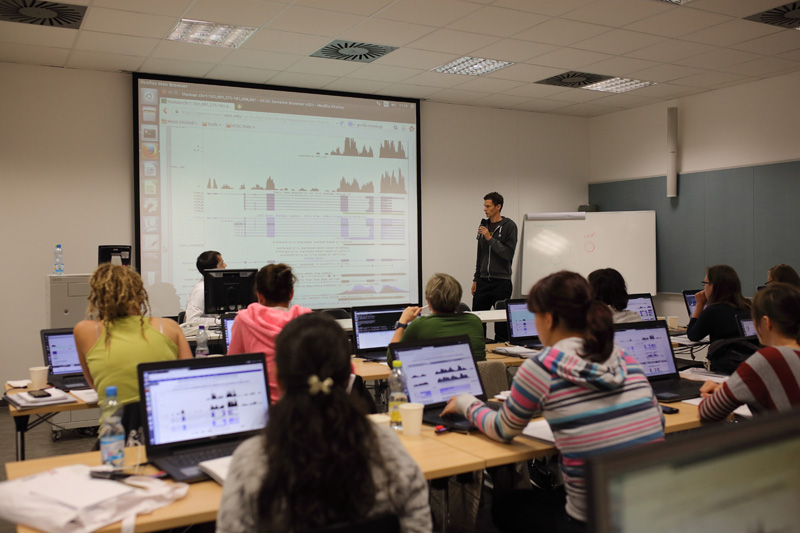
This intensive one-week summer course gives you a deep, practical understanding of Next-Generation Sequencing (NGS) with a strong focus on bioinformatics workflows. You will learn how sequencing technologies influence data quality and downstream interpretation - and how to handle common pitfalls in real datasets.
You will be trained to understand key NGS data formats and identify potential problems and error sources early. Throughout the course, we work with a real-life Illumina RNA-seq dataset.
By the end of the week, you will be able to run essential first analysis tasks independently (QC → mapping → visualization → differential expression) and gain a structured introduction to DNA variant calling. The course is designed for beginners in NGS bioinformatics and welcomes participants with little or no computer science background.
In the evenings, we offer social events such as a conference dinner and a guided city tour through Berlin - great opportunities for networking.


University
Dr. Vladimir Jovanović
Free University of Berlin

Industry
Dr. Jeremy Leipzig
TileDB (Cambridge, MA, USA)

Research Facility
Prof. Dr. Martin Kircher
University of Lübeck / University Hospital Schleswig-Holstein / Berlin Institute of Health

Dr. Gero Doose
Gero specializes in split-read analysis and downstream interpretation and has published work on circular RNAs in RNA-seq experiments. Publications

Dr. David Langenberger
David has used NGS since 2006 in multiple large-scale projects (including ICGC) and focuses on practical analysis workflows and interpretation. Publications
Dr. Mario Fasold
Mario works in the analysis of microarray data since 2007 and developed several bioinformatics tools such as the Bioconductor package AffyRNADegradation and the Larpack program package. Since 2011 he specialized in the field of NGS data analysis and helped analysing sequencing data of several large consortium projects. Publications
The target audience is biologists or data analysts with no or little experience in analyzing NGS data. A fundamental understanding of molecular biology (DNA, RNA, gene expression, PCR, …) is assumed.

Location: PC-College, Stresemannstraße 78, 10963 Berlin, Germany
Language: English
Available seats: 30 (first-come, first-served)
Registration Fee: 1,549 EUR (excluding VAT)
Travel expenses and accommodation are not covered by the registration fee.
Opening Date of Registration: December 9, 2025
Closing Date of Registration: June 12, 2026
Workshop: June 15-19, 2026 (9 am - 5 pm)
"Excellently structured and polished workshop! The material was challenging but the way it was presented made it easy to follow and fun to engage with. The tutors made the learning environment really friendly and safe, and I got much more out of this workshop than I initially expected. Thank you!" Antonina Karakostova, University of Copenhagen, Denmark
"The course provided an excellent introduction to the analysis of NGS data and covered the most relevant aspects in a well-structured and comprehensible way. The trainers did a really great job guiding us step-by-step through the NGS data analysis workflow and providing theoretical background information and lots of hands-on experience. Overall, a very informative and well-organised course - clear recommendation!" Thomas Wulff, Max Planck Unit for the Science of Pathogens, Germany
The course was dense, well paced, but no stone was left unturned, particularly for statistics and "black boxes", which I particularly enjoyed. Organisation was very good, as well. The wit and expertise of the instructors made this the best such course I have so far attended." Alex Tomazatos, Bernhard Nocht Institute for Tropical Medicine, Germany
When you register for this workshop you are agreeing with our Workshop Terms and Conditions. Please review them before you register.
ecSeq Bioinformatics GmbH
Sternwartenstr. 29
D-04103 Leipzig
Germany
Email: events@ecSeq.com