11th Berlin Summer School in NGS Data Analysis 2027
Introduction to NGS, RNA-Seq Data Analysis and DNA Variant Calling
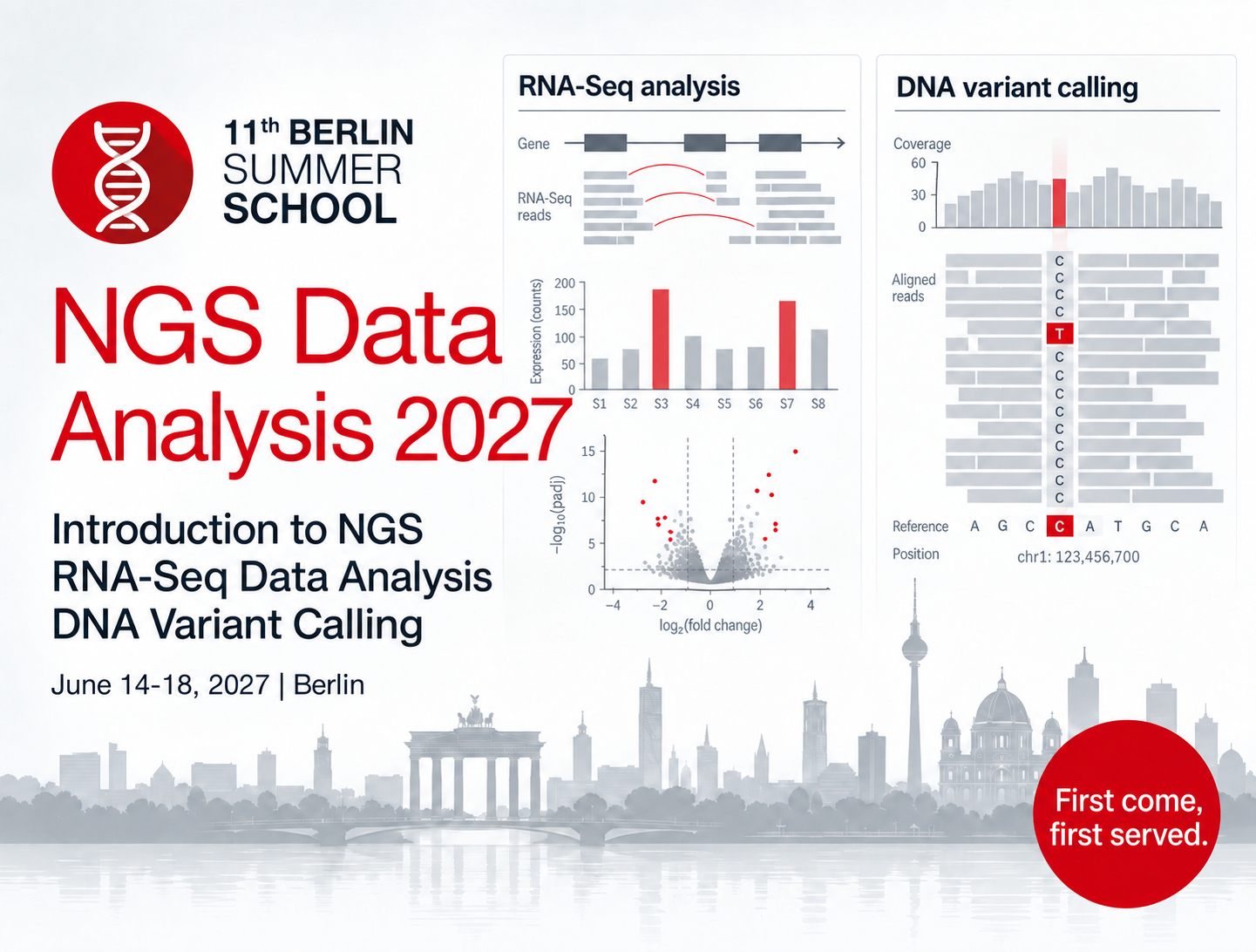
Berlin Summer School in NGS Data Analysis

Build a practical foundation in NGS bioinformatics and work through complete analysis workflows for RNA sequencing and DNA variant calling.

In a nutshell

  • Build the essential Linux command-line skills used in everyday NGS bioinformatics

  • Understand sequencing technologies, analysis algorithms and core data formats

  • Process and inspect sequencing data with widely used open-source tools

  • Analyse a real-life RNA-Seq dataset from quality control to differential expression

  • Perform a first DNA variant analysis, including variant calling and VCF interpretation
When? June 14-18, 2027
9:00 am - 5:00 pm
Where? Berlin, Germany
Register Now
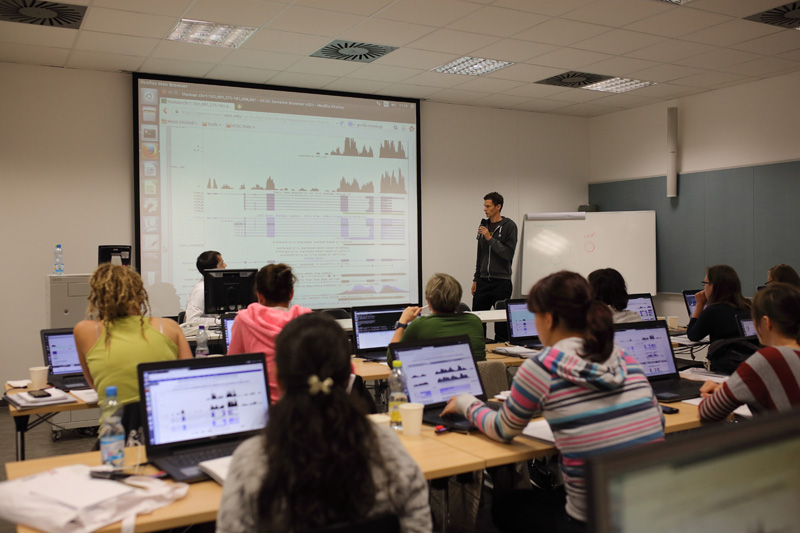
Participants working during an ecSeq bioinformatics course

This intensive five-day summer school provides a structured, practical introduction to Next-Generation Sequencing data analysis. The focus is on understanding the decisions behind a workflow, recognising common problems and learning how to inspect results critically.

Throughout the week, you will work with a real-life Illumina RNA-Seq dataset. You will move from raw-read quality control and read mapping to visualisation, quantification and differential expression analysis. A dedicated module introduces the central concepts and file formats used in DNA variant calling.

By the end of the course, you will be able to carry out essential first analysis steps independently and understand where additional validation or specialist expertise is required. The course is designed for beginners in NGS bioinformatics and welcomes participants with little or no computer science background.

The programme also includes a conference dinner and a guided city tour, providing time to exchange ideas and build connections with participants and trainers.

  1. Linux for Bioinformatics:
    Learn the essential command-line tools, file operations and working practices needed for NGS data analysis.
  2. Introduction to NGS Data Analysis:
    Understand sequencing technologies, raw-data quality control, read mapping, core file formats and visual inspection.
  3. RNA-Seq Data Analysis:
    Work through alignment, quantification, quality assessment and differential expression analysis using a real dataset.
  4. DNA Variant Calling:
    Learn the principles of variant calling, inspect VCF files and discuss filtering and interpretation.
Hands-on bioinformatics training at an ecSeq course

Detailed Course Programme


Linux Foundations for Bioinformatics

  • Introduction to the command line and essential commands
  • Working with files, directories and text-based biological data
  • Combining commands using pipes and redirection
  • Using command-line tools efficiently and reproducibly

Introduction to NGS Data Analysis

  • Sequencing technologies from a data analyst's perspective
  • FASTQ files and raw-read quality control
  • Adapter removal and quality trimming
  • Read-mapping concepts and practical alignment
  • SAM and BAM files, mapping statistics and quality assessment
  • Visual inspection of mapped reads

RNA-Seq Data Analysis

  • Spliced read alignment and transcript-aware mapping
  • Gene and transcript quantification
  • Experimental design, replicates and sources of unwanted variation
  • Normalisation and differential expression analysis
  • Diagnostic plots and interpretation of results
  • Hands-on exercises using a real-life RNA-Seq dataset

Note: Single-cell RNA-Seq is not covered in this course.

DNA Variant Calling

  • Principles and common strategies for DNA variant calling
  • Variant Call Format (VCF): structure and relevant quality fields
  • Basic filtering and annotation of genetic variants
  • Critical review and interpretation of variant-calling results

Three invited short talks will add perspectives from academia, industry and a non-university research institution. Names, affiliations and talk titles will be announced after confirmation.

University

Academic Perspective

Speaker, affiliation and talk title: TBA

A current perspective on NGS-based academic research.

Industry

Industry Perspective

Speaker, affiliation and talk title: TBA

Practical insights into the application of NGS in industry.

Research Institution

Applied Research Perspective

Speaker, affiliation and talk title: TBA

An applied perspective from a non-university research institution.

Dr. David Langenberger

Dr. David Langenberger
Trainer on Days 1-5
David has worked with NGS data since 2006 in several large-scale research projects, including ICGC. His teaching focuses on practical workflows, quality assessment and the careful interpretation of analysis results. Publications

Dr. Mario Fasold

Dr. Mario Fasold
Trainer on Days 1-3
Mario has specialised in NGS data analysis since 2011 and has contributed to the analysis of sequencing data from several large research consortia. His work includes statistical data analysis and the development of bioinformatics software. Publications

Dr. Gero Doose

Dr. Gero Doose
Trainer on Days 3 and 5
Gero specialises in split-read analysis and the downstream interpretation of RNA-Seq data. His scientific work includes the analysis of circular RNAs and complex transcriptomic signals. Publications

Requirements

The course is intended for biologists, biomedical researchers and data analysts with little or no experience in analysing NGS data. A basic understanding of molecular biology, including DNA, RNA and gene expression, is expected.

No previous Linux or programming experience is required.

  •   Carefully prepared course materials and exercise data
  •   Catering during the workshop
  •   High-performance workstations, no laptop required
  •   Conference dinner
  •   Guided city tour
  •   Networking opportunities
  •   Certificate of participation


Berlin cityscape

Attendance

Location: PC-College, Stresemannstrasse 78, 10963 Berlin, Germany
Language: English
Available seats: 30, allocated on a first-come, first-served basis
Registration fee: 1,549 EUR excluding VAT

Travel expenses and accommodation are not covered by the registration fee.

Travel information for Berlin

Key Dates

Registration: Open now
Closing Date of Registration: June 13, 2027, or when all seats are filled
Workshop: June 14-18, 2027, 9:00 am - 5:00 pm

"Excellently structured and polished workshop! The material was challenging but the way it was presented made it easy to follow and fun to engage with. The tutors made the learning environment really friendly and safe, and I got much more out of this workshop than I initially expected. Thank you!"

Antonina Karakostova, University of Copenhagen, Denmark

"The course provided an excellent introduction to the analysis of NGS data and covered the most relevant aspects in a well-structured and comprehensible way. The trainers did a really great job guiding us step-by-step through the NGS data analysis workflow and providing theoretical background information and lots of hands-on experience. Overall, a very informative and well-organised course - clear recommendation!"

Thomas Wulff, Max Planck Unit for the Science of Pathogens, Germany

"The course was dense, well paced, but no stone was left unturned, particularly for statistics and 'black boxes', which I particularly enjoyed. Organisation was very good, as well. The wit and expertise of the instructors made this the best such course I have so far attended."

Alex Tomazatos, Bernhard Nocht Institute for Tropical Medicine, Germany

Register Now

When you register for this workshop, you agree to our Workshop Terms and Conditions. Please review them before registering.


ecSeq Bioinformatics contact information

Any questions? Please contact our events team.

ecSeq Bioinformatics GmbH
Sternwartenstr. 29
D-04103 Leipzig
Germany
Email: events@ecseq.com