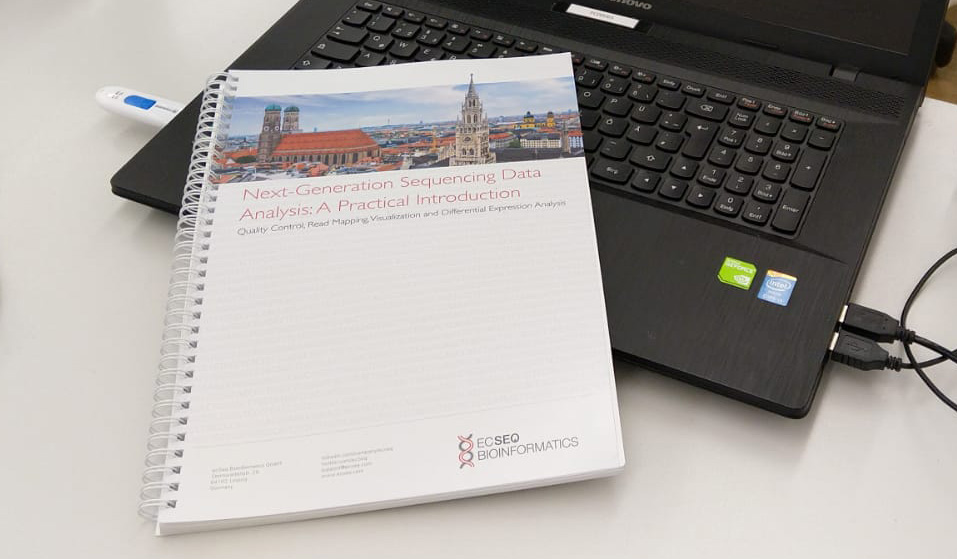
Online Course: A Practical Introduction to NGS Data Analysis and Variant Calling
Quality Control, Read Mapping, Visualisation and DNA Variant Analysis
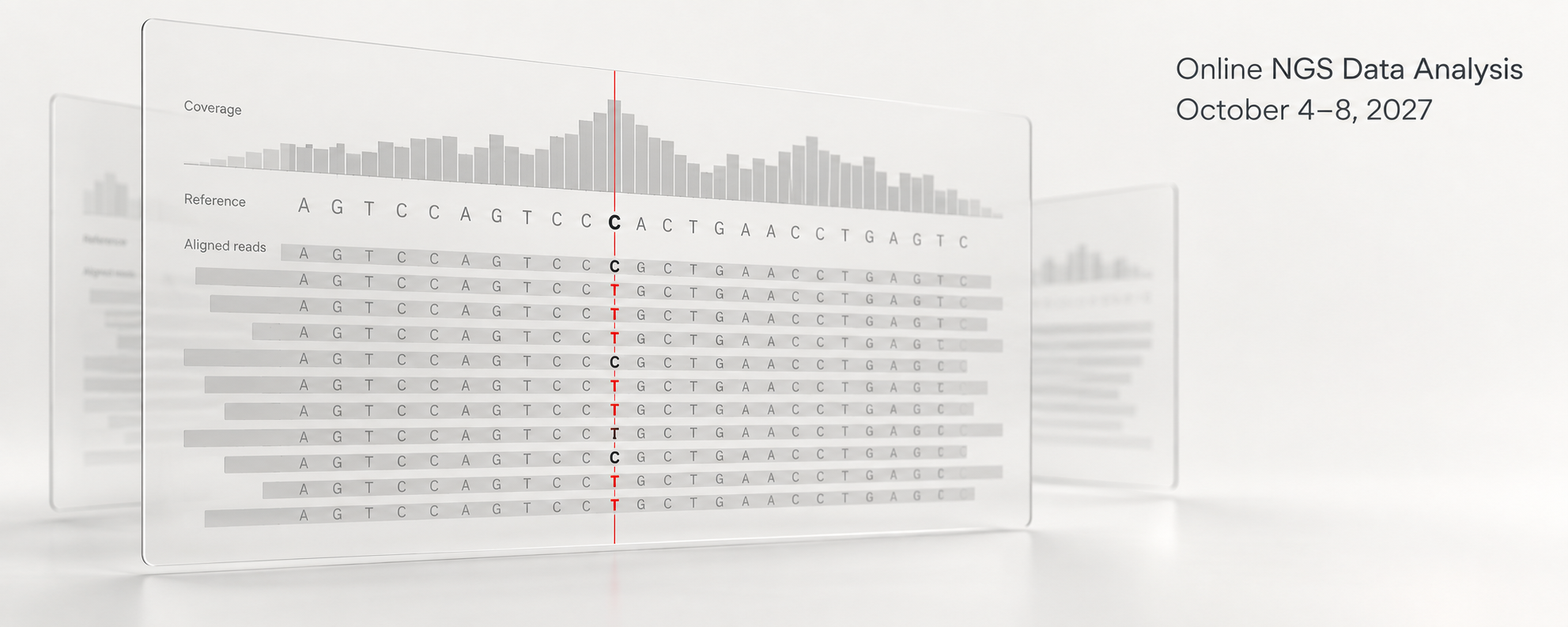
Online NGS data analysis course with quality control, read mapping and DNA variant calling

Learn how to assess NGS data, recognise common problems and perform essential analysis steps in a live, interactive online course spread across five half-day sessions.

In a nutshell

  • Build the essential Linux command-line skills used in NGS bioinformatics

  • Understand sequencing technologies, analysis algorithms and core data formats

  • Assess raw-read quality and identify common technical problems

  • Map sequencing reads and inspect alignment results

  • Perform a first DNA variant analysis, including variant calling and VCF filtering

When? October 4-8, 2027
1:00 pm - 6:00 pm Berlin time
7:00 am - 12:00 noon US Eastern Time
CEST (UTC+2) / EDT (UTC-4)
Where? Online
Register Now
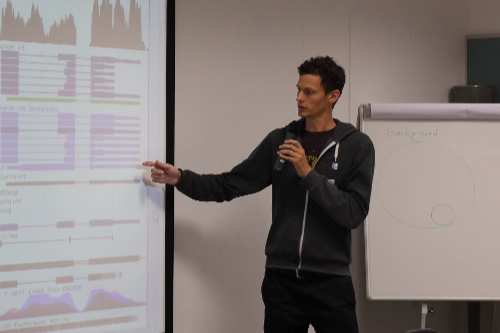
Participant attending an interactive online bioinformatics course

This online course provides a structured, practical introduction to Next-Generation Sequencing data analysis. We discuss the advantages and limitations of current sequencing technologies and explain how they affect data quality, analysis decisions and interpretation.

You will work with a real-life Illumina dataset and move from raw-read quality control through preprocessing and read mapping to alignment inspection and DNA variant calling. The focus is not only on running tools, but also on understanding their output and recognising results that require closer examination.

The course is designed for beginners in NGS bioinformatics. It is suitable for scientists with little or no computer science background who want to gain practical experience and become more confident when working with sequencing data.

All exercises are performed through a browser-based Linux terminal connected to a high-performance cloud computer. No local installation is required. The five-half-day format provides time between sessions to consolidate the material while retaining the interaction of a live course.

The schedule is designed to make live participation possible from both Europe and the Americas. During the course week, each session runs from 1:00 pm to 6:00 pm in Berlin, corresponding to 7:00 am to 12:00 noon on the US East Coast.

Get trained by experts

Our trainers combine academic and industrial experience in NGS data analysis. They explain the reasoning behind each step and discuss practical questions as they arise.

Work with open-source tools

We focus on widely used open-source software and show how different tools and parameters affect an analysis.

Learn with carefully prepared materials

Course materials and example datasets are designed to support both the live exercises and independent repetition after the course.


Browser-based cloud environment for online NGS training

The course combines concise explanations, live demonstrations and guided hands-on exercises. Its content is distributed across five half-day sessions:

Linux Foundations for Bioinformatics

  • Introduction to the command line and essential commands
  • Working with files, directories and text-based biological data
  • Combining commands using pipes and redirection
  • Introduction to FASTA, BED and related bioinformatics formats

Sequencing Technologies and Raw-Read Quality Control

  • Sequencing technologies from a data analyst's perspective
  • NGS applications, terminology and common error sources
  • FASTQ files and interpretation of quality scores
  • Quality assessment with FastQC
  • Adapter removal and quality trimming

Read Mapping and Alignment Inspection

  • Fundamentals of alignment methods and mapping heuristics
  • Read mapping with widely used tools
  • SAM and BAM files
  • Basic use of samtools
  • Mapping statistics and visual inspection of aligned reads

DNA Variant Calling

  • Principles and common strategies for variant calling
  • From mapped reads to candidate variants
  • Sources of false-positive and false-negative calls
  • Practical variant-calling exercise

VCF Filtering and Interpretation

  • Structure of the Variant Call Format
  • Relevant quality fields and genotype information
  • Basic filtering and annotation
  • Critical review and interpretation of results
  • Summary, questions and next steps

The exact allocation of individual topics to course days may be adjusted to the progress of the group.

Dr. David Langenberger

Dr. David Langenberger
Trainer
David has worked with NGS data since 2006 in several large-scale research projects, including ICGC. His teaching focuses on practical workflows, quality assessment and careful interpretation. Publications

Dr. Mario Fasold

Dr. Mario Fasold
Trainer
Mario has specialised in NGS data analysis since 2011 and has contributed to the analysis of sequencing data from several large research consortia. His work includes statistical data analysis and bioinformatics software development. Publications

Dr. Gero Doose

Dr. Gero Doose
Technical and backend support
Gero supports the technical course environment and helps ensure reliable access to the browser-based analysis platform throughout the workshop.

Requirements

The course is intended for biologists, biomedical researchers and data analysts with little or no experience in analysing NGS data. A fundamental understanding of molecular biology, including DNA, RNA and gene expression, is expected.

No previous Linux or programming experience is required.

Participants need a desktop computer or laptop with an up-to-date Chrome or Firefox browser, a stable internet connection, a microphone and headphones or speakers.

  •   Carefully prepared course materials and exercise data
  •   Access to a high-performance cloud computer for all hands-on exercises
  •   Browser-based analysis environment with no local installation required
  •   Live support during practical exercises
  •   Certificate of participation


Materials and cloud access included with the online NGS course


Live assistance during an online bioinformatics course
  •   Live teaching with direct interaction instead of pre-recorded videos
  •   Hands-on use of essential NGS tools and real analysis data
  •   Individual help and feedback during exercises
  •   No local software installation; analyses run on a cloud computer in your browser
  •   Five half-day sessions that leave time to review and consolidate each day's material

Attendance

Location: Online, live and interactive
Language: English
Available seats: 25, allocated on a first-come, first-served basis
Registration fee: 879 EUR excluding VAT

Key Dates

Registration: Open now
Course: October 4-8, 2027
Format: Five live half-day sessions
Daily schedule: 1:00 pm - 6:00 pm Berlin time
US East Coast: 7:00 am - 12:00 noon
Time zones: CEST (UTC+2) / EDT (UTC-4)

"The handout, as well as the setting (terminal login and zoom) was absolute in time and accurate. The frame of the workshop equips one with enough information to get started for the first NGS data set analysis. The four trainers were super friendly, open to help and most competent. The course is highly recommended."

André Riedl, Bavarian Nordic, Germany

"I was blown away by the Course. I did some similar courses in the past and got little or nothing from them. This workshop gave me the ability to understand what is actually written in the command line, how to read it and the data and how to do the simple analysis myself. I am not terrified of the command line anymore. Actually, I can't get enough of it now. Also, I tried to reproduce the whole pipeline on my own data and actually got it all done using the knowledge and the resources from the workshop. All I need now is experince in reading the analysis :-D"

Sanja Duvnjak, Croatian Veterinary Institute, Croatia

"The course is very well structured and focuses all the main topics on NGS data analyses, with the appropriate detail for beginners. The tutors are excellent and very friendly and mentioned a lot of details, which only experienced users know. I have learnt a lot!"

Alexandra Rosa, University of Madeira, Portugal

Register Now

When you register for this workshop, you agree to our Workshop Terms and Conditions. Please review them before registering.


You need a desktop computer or laptop with an up-to-date Chrome or Firefox browser, a stable internet connection, a microphone and headphones or speakers. The practical exercises are not suitable for phones or tablets.

No. You will use a Linux terminal running on a high-performance cloud computer. It is accessed directly through your web browser and already contains the software required for the exercises.

Yes. This is a live course rather than a collection of recorded lessons. The exercises build on one another, so participants should attend all five sessions from 1:00 pm to 6:00 pm Berlin time.

Yes. The trainers and technical support can help during the practical exercises. When necessary, support can view your browser-based course terminal. They cannot access other applications, files or areas of your computer.

No. The course starts with the Linux command-line foundations required for the later exercises. A basic understanding of molecular biology is expected.

During the course week, the sessions run from 7:00 am to 12:00 noon US Eastern Daylight Time (EDT) in cities such as New York, Boston and Washington, D.C. This corresponds to 1:00 pm to 6:00 pm Central European Summer Time (CEST) in Berlin.

ecSeq Bioinformatics contact information

Any questions? Please contact our events team.

ecSeq Bioinformatics GmbH
Sternwartenstr. 29
D-04103 Leipzig
Germany
Email: events@ecseq.com