3rd Berlin Winter School in RNA-Seq Data Analysis
From Raw Reads to Differential Gene Expression
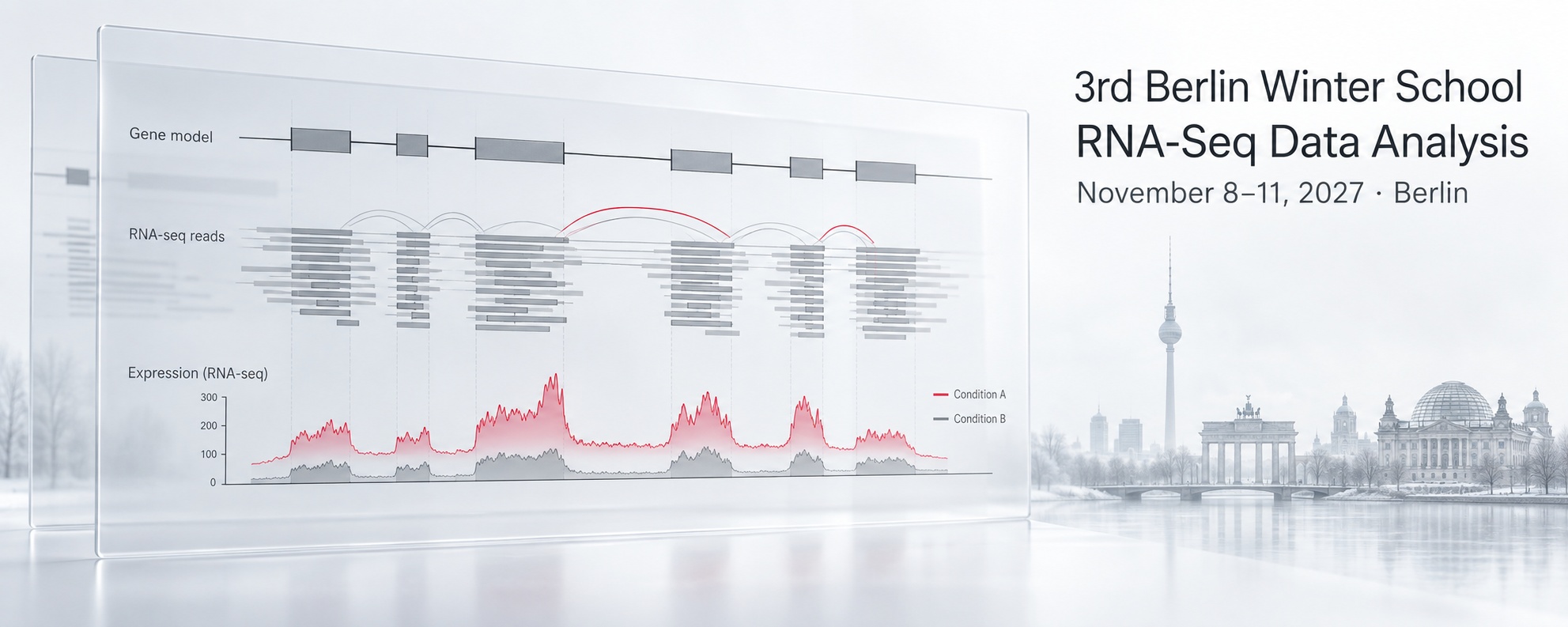
Berlin Winter School in RNA-Seq Data Analysis 2027

Understand the challenges of bulk RNA-Seq data analysis and learn how to solve them in a structured, hands-on workflow.

In a nutshell

  • Build the essential Linux command-line skills used in RNA-Seq bioinformatics

  • Understand RNA-Seq technologies, analysis algorithms and core data formats

  • Assess raw-read quality and recognise common technical problems

  • Map and quantify RNA-Seq reads using widely adopted open-source tools

  • Create diagnostic graphics and evaluate analysis quality

  • Perform and interpret differential gene expression analysis with DESeq2
When? November 8-11, 2027
9:00 am - 5:00 pm
Where? Berlin, Germany
Register Now
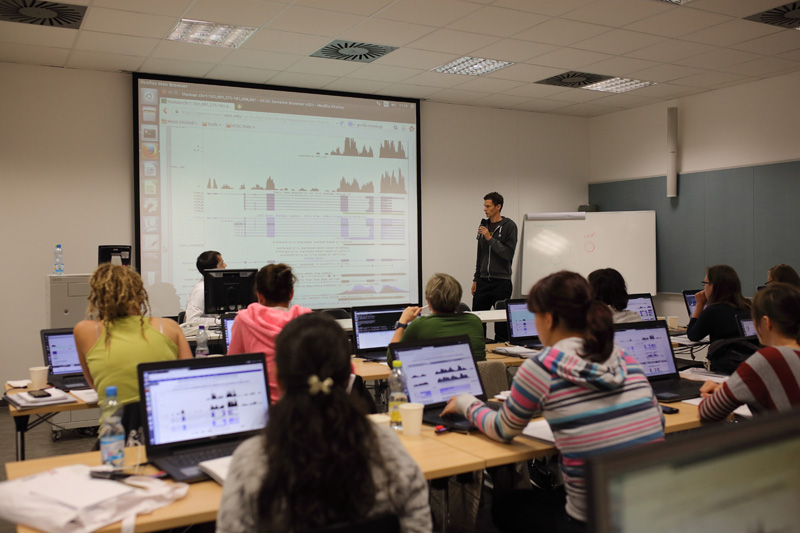
Hands-on bioinformatics training environment

This four-day winter school provides a practical introduction to bulk RNA-Seq data analysis. It combines the biological and statistical concepts behind the workflow with extensive hands-on exercises on a real-life Illumina dataset.

You will move from raw sequencing reads through quality control, preprocessing, alignment and transcript quantification to count matrices, exploratory analysis and differential gene expression. The emphasis is on understanding why each step is performed, how to assess its output and how to recognise results that require closer examination.

The course is designed for beginners in NGS bioinformatics. Scientists with little or no computer science background receive a structured introduction to Linux and the command line before applying established open-source tools to RNA-Seq data.

All practical work is performed on high-performance Linux workstations provided at the venue. No personal laptop or local software installation is required.

Please note: This course focuses on bulk RNA-Seq. Single-cell RNA-Seq data analysis is not covered.

Learn from experienced bioinformaticians

Our trainers combine academic and industrial experience in RNA-Seq data analysis. They explain the reasoning behind each step and discuss practical questions as they arise.

Work with open-source tools

We use established open-source software and show how tool choice, parameters and experimental design affect the analysis.

A reproducible analysis workflow

You will understand the complete path from FASTQ files to interpretable differential expression results.

Curated course materials

Course materials, exercises and the analysis environment remain available for review and continued learning after the workshop.

The course comprises four connected modules. Short lectures introduce the concepts before participants apply them in guided practical exercises.

Linux and RNA-Seq Foundations

  • Introduction to the Linux command line and essential commands
  • Working with files, directories, pipes and redirection
  • RNA-Seq experimental design and sequencing technologies
  • Core formats: FASTQ, GTF/GFF, SAM/BAM and count matrices
  • Reference genomes, annotations and commonly used databases

Raw-Read Quality Control, Alignment and Quantification

  • Assessing raw-read quality with FastQC
  • Adapter contamination, quality trimming and common artefacts
  • Principles of splice-aware read alignment
  • Aligning RNA-Seq reads with STAR
  • Transcript quantification with Salmon
  • Alignment statistics and visual inspection with IGV

Count Data and Differential Gene Expression

  • Generating and understanding gene-level count matrices
  • Importing and exploring count data in R
  • Library-size effects, normalisation and dispersion
  • Experimental design, contrasts and confounding factors
  • Differential gene expression analysis with DESeq2
  • Diagnostic plots, sample relationships and quality assessment

Interpretation, Reporting and Applied Exercises

  • Interpreting fold changes, p-values and adjusted p-values
  • Recognising technical and biological sources of variation
  • Visualising differential expression results in R
  • Discussing transcript- and isoform-level questions
  • Applying the complete workflow to challenging exercises
  • Strategies for transferring the workflow to your own data

The exact allocation of individual topics to course days may be adjusted to the progress of the group.

Dr. Gero Doose

Dr. Gero Doose
Trainer
Gero has extensive experience in bulk RNA-Seq and split-read analysis. His work includes the discovery and characterisation of circular RNAs and the development of robust downstream analysis strategies. Publications

Dr. Mario Fasold

Dr. Mario Fasold
Trainer
Mario has specialised in NGS data analysis since 2011 and has contributed to sequencing analyses in several large research consortia. His expertise includes statistical data analysis and bioinformatics software development. Publications

Requirements

The course is intended for biologists, biomedical researchers and data analysts with little or no experience in analysing RNA-Seq data. A fundamental understanding of molecular biology, including DNA, RNA and gene expression, is expected.

No previous Linux, R or programming experience is required.

  •   Course materials and practical exercises
  •   Catering during the workshop
  •   High-performance workstations - no laptop required
  •   Conference dinner
  •   Guided city tour
  •   Networking opportunities
  •   Certificate of participation
  •   Downloadable analysis environment for continued learning after the course
Berlin skyline

Attendance

Location: Berlin, Germany
Language: English
Available seats: Limited; first come, first served

Registration fee: To be announced

Travel expenses and accommodation are not included in the registration fee.

Travel information for Berlin

Key Dates

Registration opens: Open now
Registration closes: November 7, 2027, or when all seats are filled
Winter School: November 8-11, 2027
Daily schedule: 9:00 am - 5:00 pm

"I was particularly impressed with the emphasis on teaching us how to think about our analyses, rather than just follow a series of commands. The active exercises were clearly designed extraordinarily carefully and were really effective not just in applying what we had learned, but in seeing how you might fall into an analysis or interpretation trap if you are not careful."

Morgan Benowitz-Fredericks, Bucknell University, USA

"The RNA-Seq workshop provided essential insights into working with RNA-Seq data. Starting with Linux basics and setting up a working environment was particularly helpful for someone without previous knowledge. This workshop significantly enhanced my proficiency in genomic data analysis."

Miroslav Bardelčik, Masaryk Memorial Cancer Institute, Czech Republic

"The workshop did not only teach you how to run a certain pipeline, but demonstrated the basic principles of how the pipeline works. I also learned to evaluate my results and compare different tools for answering specific biological questions."

Ridzky Anis Advent Yuda, Center for Regenerative Therapies Dresden, Germany

Register Now

By registering for this workshop, you agree to our Workshop Terms and Conditions. Please review them before registering.

ecSeq Bioinformatics

Any Questions?

Please feel free to contact our events team.

ecSeq Bioinformatics GmbH
Sternwartenstr. 29
D-04103 Leipzig
Germany
Email: events@ecseq.com