A Practical Introduction to NGS Data Analysis and Variant Calling
From Quality Control and Read Mapping to DNA Variant Calling (VCF)
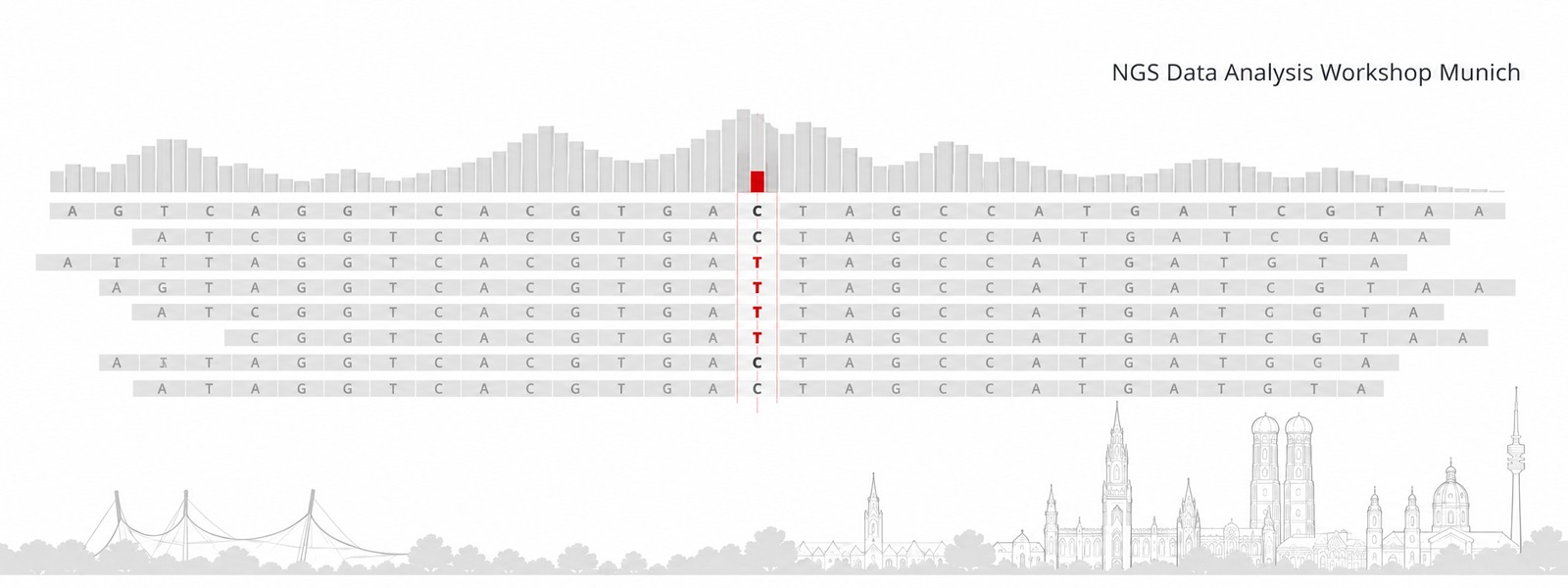
NGS data analysis and variant calling workshop in Munich

Learn how to assess NGS data, recognize common pitfalls, and perform the essential steps from raw-read quality control to DNA variant calling in a structured, hands-on workflow.

In a nutshell

  • Build the essential Linux command-line skills used in everyday NGS bioinformatics

  • Understand key NGS concepts: technology, algorithms, and file formats (FASTQ, BAM, VCF)

  • Use widely adopted open-source tools to process and inspect sequencing data

  • Perform a first DNA variant analysis, from variant calling to basic VCF filtering

When? March 22-24, 2027
9:00 am - 5:00 pm
Where? Munich, Germany
This workshop gives you a practical introduction to Next-Generation Sequencing (NGS), with a clear focus on the bioinformatics decisions that determine whether an analysis is trustworthy.

You will learn how to assess your own NGS data, identify common problems and sources of error, and complete a first analysis workflow that includes DNA variant calling.

During the course, you will work with a real Illumina NGS dataset and use widely adopted open-source tools.

By the end of the workshop, you will be able to:

  • Evaluate raw sequencing data in FASTQ format using quality-control best practices

  • Perform preprocessing (adapter clipping, quality trimming) and understand why you do it

  • Map reads to a reference genome and interpret mapping quality (SAM/BAM)

  • Inspect alignments in IGV/UCSC to validate findings

  • Generate and interpret a VCF file, apply basic filters, and recognize common pitfalls

Go to registration.

Get trained by experts

Our trainers bring extensive academic and industry experience in NGS data analysis, so your questions are answered with practical and up-to-date context.

Open source NGS tools

We use widely adopted open-source tools and compare alternatives where appropriate. The right tool depends on the biological question, the data, and the analysis goal.

Learn effectively with well-curated materials

We provide carefully prepared datasets and step-by-step exercises. You can take home the course materials, tools, and results to continue working after the workshop.

Hands-on NGS bioinformatics training

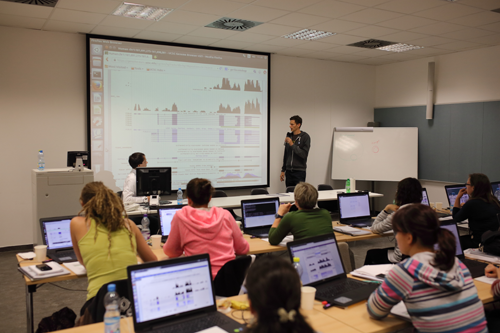
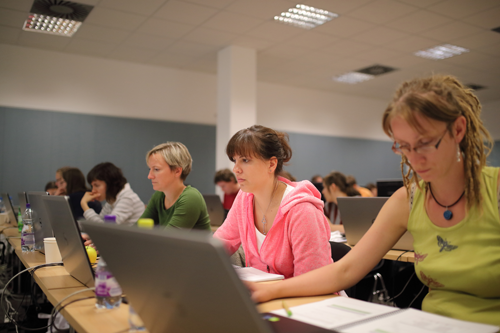
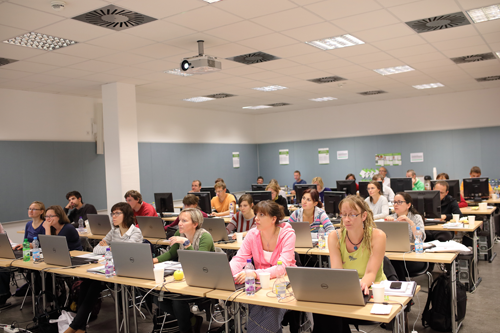
Practical exercises during an ecSeq bioinformatics workshop

This beginner-friendly workshop combines short theory blocks with extensive hands-on exercises. It consists of three modules:

  1. NGS Technologies:
    Compare sequencing methods and understand the implications for data analysis.
  2. Practical Bioinformatics with Linux:
    Learn the essential command-line tools and file formats used in NGS workflows and overcome the typical first hurdles.
  3. Introduction to NGS data analysis:
    Work through essential analysis tasks, from quality control to variant calling.

Detailed Course Program


NGS Technologies

  • Sequencing technologies from a data analyst's perspective
  • Common NGS data analysis issues, error sources, and typical artefacts
  • Applications of sequencing technologies
  • Notations and NGS terminology

Practical Bioinformatics (with Linux)

  • Introduction to the command line and essential commands
  • Combining commands using piping and redirection
  • Bioinformatics file formats and databases (e.g., FASTA, BED, UCSC)
  • Working with important toolkits (e.g., samtools)

Introduction to NGS data analysis

  • Raw sequence files (FASTQ format)
  • Preprocessing: QC (FastQC), adapter clipping, quality trimming
  • Read mapping fundamentals (alignment methods, mapping heuristics)
  • Read mapping with common tools (BWA-MEM, Bowtie2, STAR, segemehl)
  • Mapping output (SAM/BAM) and core toolkit (samtools)
  • Mapping statistics and interpretation
  • Visualization of mapped reads (IGV, UCSC)
  • DNA variant calling → VCF → filtering variants

Trainers

Dr. David Langenberger

Dr. David Langenberger
David has worked with small non-coding RNAs since 2005 and has used NGS technologies since 2006 in multiple large-scale projects, including ICGC. Publications

Dr. Mario Fasold

Dr. Mario Fasold
Mario has worked in bioinformatics since 2007 and has specialized in NGS data analysis since 2011, supporting multiple large consortium sequencing projects. Publications

Requirements

Who is this workshop for: Biologists and data analysts who work with NGS (or plan to) and want a structured, practical entry into NGS data analysis.

Assumed knowledge: A fundamental understanding of molecular biology (DNA, RNA, gene expression, PCR, ...)

Helpful but not required: Basic Linux/bioinformatics familiarity (command line, common tools). We start from the basics and guide you step-by-step.

Clarity note: You will work on the Linux command line, but this is not a programming course.

  •   Printed course materials
  •   Catering during the workshop
  •   Conference dinner
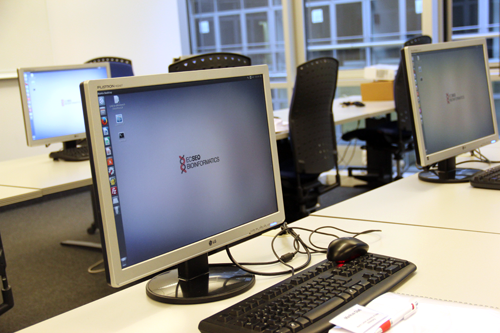
  •   High-performance workstations (no laptop needed)
  •   Downloadable environment for seamless continuation after the course
  •   Certificate

Computer workstation provided for the practical exercises

Attendance

Location: cmt GmbH, Hansastraße 32, 80686 Munich, Germany

Language: English

Available seats: 20 (first-come, first-served)

Registration Fee: 989 EUR (excluding VAT)

Travel expenses and accommodation are not covered.

Travel Information - Munich

Key dates

Registration: Opening soon

Closing Date of Registration: To be announced

Workshop: March 22-24, 2027, from 9:00 am to 5:00 pm

"This is an excellent course that combines theory and practice in an exceptionally clear and accessible way. The lectures are well-organized, and the material is presented in a structured and logical manner, which makes it easy to grasp complex concepts. Particularly impressive is that the course includes real-life examples and exercises, allowing for immediate application of what has been learned. The instructors are knowledgeable, motivating, and always ready to answer questions, creating a friendly and stimulating learning environment." Krasimira Rusinova-Ilieva, Molecular Medicine Center (MMC), Medical University - Sofia

"Great course, very well organized and easy to follow, as someone not from that background. The teachers explained everything well and were patient. Great atmosphere overall." Patricia Parreira Perin, University of Turin

"The course was conducted at an exceptionally high level. As a beginner in bioinformatics, I found the step-by-step guidance on data analysis and downstream processes incredibly clear and helpful. Although the 3-day format was very intense and at times overwhelming, I am very glad I participated. It was a challenging but rewarding experience." Marta Michalak, Medical University of Lodz


When you register for this workshop, you agree to our Workshop Terms and Conditions. Please read them before registering.


ecSeq Bioinformatics contact information

Any questions? Please contact our events team.

ecSeq Bioinformatics GmbH

Sternwartenstr. 29

D-04103 Leipzig

Germany

Email: events@ecSeq.com